Selasa, 24 Agustus 2010

Jay Dunitz: Sculpture, Process & Image


It isn't possible to accurately convey the quality of Jay Dunitz's Cibachrome@ images via my digital camera scans of the plates from his book Pacific Light [Hillsboro, Oregon: Light Press, 1989], to a degree requisite for even a base-level apprehension of the work, but let my brief note here serve as an introduction and teaser. 
 
I'm not a gallery hopper. Indeed, I rarely attend art exhibitions, and probably discover more art through books than I ever have "in person." That's how I found out about Jay Dunitz's art, by seeing his book Pacific Light in a bookstore. Pacific Light's a standard, large format, "coffee table" art book--but the similarity ends there. 
 
The trend among photographers to blend media--specifically, to incorporate aspects of painting and sculpture into photographic imagery--has been going on for at least two decades. Jay Dunitz, who graduated from the San Francisco Art Institute in 1978, was separately inspired by the work of Mark Rothko and Clyfford Still, as well as the photographic work of Minor White and Aaron Siskind. (I have discussed the work of White earlier on this blogsite.*)
 
Dunitz was restless--he didn't know exactly what he was looking for, but he knew he'd recognize it (intuitively) once he saw it. By accident, in 1980 he discovered several heaps of discarded metal scraps left to weather outside Kroeber Hall (on the UC Berkeley campus) by sculpture students. He immediately set to work photographing these rusted detritus, which formed the body of his first important work: the Kroeber Series (represented by the last four color images shown below).     


Moving to Southern California in 1984, he began to experiment with manipulating the surface of stainless steel, using a blow-torch, a grinder and a wire brush. The colors and textures thus produced through manipulation were fleeting, so a method was needed to fix the image, to preserve the marvelous qualities of the freshly marred metal surface. As he moved on to experiment with reactive metal such as titanium, niobium and tantalum, Dunitz refined a technique that would revolutionize two dimensional imagery. Wiring an artist's paintbursh to a power supply and voltage regulator, he learned to paint metal with nothing more than direct current, water, and baking soda, which he added to help conduct electricity. Light, composed of many colors, each a different wavelength; the electricity flowing through the paintbrush created a clear oxide layer where the bristles touched the plate. When white light struck this layer, some of its waves were immediately reflected, while others penetrated to the metal substrate before bouncing back. Those that reemerged in sync with the first set of reflectwd waves were seen as a pure color. Called "interference" this phenomenon enabled Dunitz to "paint with light" selecting the proper voltage setting to determine the color. Once this process was completed to his satisfaction, he set about photographing the result with a 4x5 camera using color positive transparency film, illuminating the surface with high-output halogen spots. From these transparencies, large-format Cibachrome@ [silver impregnated color] images are made.          
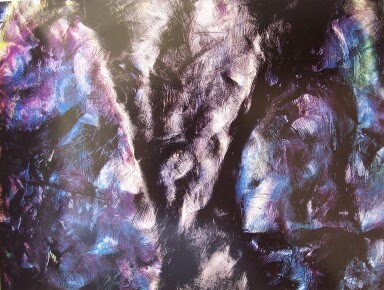
  
Dunitz's imagery bears a striking resemblance to earlier painterly explorations--notably the Abstract Expressionists--Still, Pollack, Rothko, Tobey, Hoffman, Motherwell, Guston, etc.--but its surface qualities set it distinctly apart.  


The use of the metal medium expands the potentials of two-dimensional expression to include the abrasion of the sensitized surface, rather than the mere application of a substance, such as paint. The use of means to manipulate the surface suggest sculpture (or possibly even collage). Finally, the necessity of photographing the result, which is ephemeral and fades quickly, adds still another dimension to the process.


Life Magazine photographed Jackson Pollack in his studio, looking down upon his huge canvases on the floor, paint can in hand, throwing or dripping blobs and droplets and streaks and splashes of color in successive layers of oil paint. There was an athletic quality to the large format body movements which Pollack undertook to create those large "gestural" canvases. 


Dunitz's explorations of the stainless steel surface with his unique technology of tools and chemistry is another step in the historical progression of the manipulation of a surface to create novel, original imagery. His signature piece, Pacific Series #28 (above) is a grand realization of the abstract potential of post-Impressionist subject matter seen through an Expressionist's palette.    
 

As in Cezanne, we are conscious of the medium's paths and marks, the residue of the materials of the hand, but the template of the superimposed colors and strokes sings a coincident music, of the beauty of the eye's ability to "see" variations constructed out of the discrete valences of the visual context. The bite left by the grinder's successive indents suggest segmentation, blurred (visual procession--Bergson) movement, focal coherence, a surreal spectrum of color.      


The Kroeber Series is breathtakingly vivid, the intense iron oxide orange a kind of sandpapery metaphysical abrasion to the mind. The use of unreal colors in the evocation of symbolic or surreal imagery has led photographers to branching pathways. 


In straight landscape color photography, photographers have felt permission to push the limits of color in "real" landscapes, to intensify the feeling of being in nature, or in heroic or disorienting contexts. Exaggerations of the tawny or delicately shaded gradations of color found in nature has become commonplace among commercial, art and advertising photography. Photographers have used the pretext that the "intensity of the feeling" demands a more extreme version of the visual, to capture the extra-sensual qualities of a place and a moment. Abstract image-makers have taken the other path, following the lead of the painters and sculptors of the early Modernist, or post-Modernist, periods, to exploit the opportunities first explored in those less constricted media, by essaying pure color and form.          


Dunitz clearly belongs to this second group. However, his adherence to the clear focus and sharply etched delineation of shape and definition of objects suggests the precisionist's delight in the actual, the measured, the exact measure. He's a sort of objectivist of surface materiality, etching along the edge of sculptural space, like a welder of light.     


Looking at his beautiful color plates, I'm moved to wander, as I once did as a teenager, among abandoned industrial sites, construction projects, and factory buildings--the detritus of the modern world, the archeology of disjecta, the divine effluvia of our age.  
______________

Sabtu, 21 Agustus 2010

Sudek - The Poet Photographer of Praha (Prague)


Josef Sudek's [1896-1976] life and career is the record of an heroic overcoming of odds--physical, psychological, political, aesthetic--to produce a body of work combining tender humility, unique vision, and devoted craftsmanship. That he should even have succeeded in accomplishing this is as unlikely an outcome, as that it should ever have seen the light of day, given the obstacles to its realization. As an account of the experience of a single individual against the panorama of historical event, it's a courageous story, but the point of Sudek's work--its importance as art--is not merely a record of a certain time and place, but a poetical vision whose truth and interest transcends external event. The singular character of his photographic oeuvre could have happened in any place, assuming the determination required to do it. That this should have happened in Prague, instead of Paris, or London, or New York, or Rome, reflects the accidental nature of fate. Czechoslovakia has an impressive place in the history of photography, and Sudek is very close to the heart of that national tradition. 


The most obvious fact to report about him was that he lost his arm in the First World War. There were many casualties in "The War To End All Wars." Like Paul Wittgenstein, he lost his right arm to amputation, resulting from a gangrene infection in a military hospital. For the rest of his life, Sudek would bear the emotional, as well as the physical scar of this wound. Just the difficulties and expediencies necessary to carry on as an active photographer, make his production impressive and inspiring. 


Following the war, Sudek abandoned book-binding to become a part-time commercial photographer. Living partly on his veteran's pension, he eeked out a marginal existence, with the help of occasional assistants. During the early 1920's he pursued the prevailing "pictorialist" "soft focus" style then in vogue, though by 1924 he had co-founded the progressive Czech Photographic Society devoted to clear focus, and the "integrity" of the negative. This early commitment to clarity and honesty of image was ahead of its time, even in the West, where the f64 Group wouldn't be formed until the early Thirties.   


Following an emotional crisis in 1926, occasioned by an unfortuitous visit to the place where he had first been wounded in 1916, he underwent an aesthetic transformation, rejecting soft focus, and human subjects, for purely representational matter, devoid of portraiture. Embracing clarity and abstraction, he began to pursue a personal vision through the exploration of intimate detail, in landscape, still life, penumbral effects, the interpolation of translucent or transparent surfaces (glass). Limited somewhat by his physical disability, he compensated by documenting the internal landscape of his studio, his yard, and other proximities. The repressive German occupation during the Second World War, was followed by a period of domination by the Soviet Union, which lasted until the break-up of the Soviet Empire in 1991. During this entire period, maintaining an artist/intellectual profile was a chancy affair. Sudek was not controversial, but he took considerable risks publicly photographing Prague and the surrounding countryside during these decades (1940's, 1950's).        


Like the man himself, his work is usually modest in conception, reductive, quiet, delicate. Though a private, retiring man, who wouldn't even show up for his exhibitions, he liked to entertain friends, listening to music from his extensive classical music record collection. His compositions aren't elaborate or "staged" but feel extemporaneous, with a kind of opportunistic dailiness to them which may belie their intense concentration and meditative focus.      


Word about Sudek's work started to reach the West in the 1960's, after his first books began to appear in Czech. The first important monograph outside of Czechoslovakia was Sonja Bullaty's Sudek [New York: Clarkson Potter, Inc., in 1978], two years after his death in 1976. Bullaty had briefly been Sudek's assistant in the 1940's, before she emigrated to the U.S. During the following three decades, Sudek sent her a steady stream of prints, which form the basis for the book. Two earlier collections of his work--both done in Czech, and both with plates reproduced via elegant photo-gravure process--Fotografie [Edice Mezinarodni Fotografie and Pressfoto, Prague, 1976], and Praha Panoramaticka [Statni Nakladateistva Krasne, Prague], the second containing Sudek's renowned panoramic photographs of Prague--are now expensive rare editions.  


Sudek's photographs have a curiously moody quality, which is partly the result of a claustrophobic confinement of vision. His views of the world significantly narrow our the viewer's sense of (available) space, as if the world he (the photographer) inhabited was limited not only by his actual physical space, but by a metaphysical constriction of vision, a kind of reduction of the coordinates of spacial  possibility as transmitted by the photographic lens. From a photographic perspective, this makes perfect sense. Looking through a ground glass, under a dark-cloth, can frequently seem like a wholly self-sufficient theatre of potential. Striving to achieve clarity throughout the full depth of field, composing the frame to a degree of order and inclusivity, can fully occupy the mind.    


The sense of psychological isolation, implying the coercion and oppression of life under a totalitarian regime, is also an aspect of Sudek's aesthetic. Of life seen through the streaked panes of a chilly, unheated flat in the dead of winter, an egg or a glass of soda posed beside a cut loaf of rye bread; a lonely, private yard scattered with rusting, neglected lawn furniture, in one chair a ghostly half-exposed figure slumped over in obscure twilight. Simple objects and surfaces discovered about a large, seemingly empty city, at dawn, or dusk.      


This barrenness, plainness, suggests privation, neglect, privacy, seclusion, remoteness, and ultimately a kind of desolation, comprising a catalogue of moments, plucked from under the watchful eyes of censors, the guardians of mediocrity and regimentation. Sudek's freedom, his symbolic physical impotence, is redeemed by the powerful silences and poise of his imagery.  


This is an art practiced under the heavy, glowering presence of repression, the implacable circumstance of enforced drudgery, which survives by stealth, secrecy, and watchfulness.


The sense of a secret art, practiced in private, out of the meanest of conditions, in an endless grey cityscape, composed of murmuring lyric refusals, mournful laments for a once bustling, cosmopolitan culture, subsisting on hope and a little bread. 


I remember when I first saw a book of Sudek's images. They weren't exciting, they didn't demand to be looked at. They seemed almost crudely vivid. But the closer I looked, the more I was intrigued. They were contact prints, and the level of detail and textural contrast was meticulous. This was a photographer who relished the delicate effects possible with large format negatives, contact printed, without blur or exaggerated contrasts. It was someone who loved the glowing streetlamp behind the silhouette of a winter tree branch, the twiggy bristle of shrubbery coated with morning frost, the glint of a highlight reflected off a shard of broken glass in an alley; who saw the weird angles and pleasant disorientation of a mirror resting on the curve of a chair arm. You could feel the chill in his winter views.      


Despite his disability, Sudek would rise early, long before dawn, and lug his heavy cameras, tripod and film holders along deserted city streets (as Atget had before him, years before, in Paris), out beyond the avenues, to the silent countryside, still wet with dew, obscured by eerie ground-fogs. He loved Prague, and spent many mornings, while its inhabitants slept, capturing its broad vistas, picturesque cobbled streets, centuries-old inner city structures. 


Sudek's example is an inspiration to anyone who believes that limits cannot be overcome, or that a seeming lack of access to "meaningful" subject-matter should be an excuse for despair or passive acceptance. It's also the story of culture surviving under challenge. How much would any of us be willing to sacrifice to afford another box of film, a package of print paper? Go without a warmer winter coat, or a bottle of beer, to resupply with a new batch of developer, or tape to mend a leaking bellows? To live with clutter, disarray, and a continuing state of semi-confusion and decay, for the sake of a few precious pictures.      


Deprivation may seem its own justification under these conditions. Fate plays tricks on us. Try living your whole adult life with only one arm. Try shaving, dressing, bathing, combing your hair, cooking an egg, or riding the trolley--with just one arm. Try producing immaculate contact prints, in the darkroom, with just one arm. (Even with a partially trained assistant, this is certainly no picnic.) Try living alone for fifty years, under Nazi and Soviet domination, in grinding poverty. Try getting up in the morning when it's 40 degrees inside! Try bathing in cold water. Try being an artist in a world that denies art.   
  
 
Despite this, there is joy in Sudek's art. With the dawn's rays just peeking over the horizon, stabbing his tired, keen eyes, he was tickled with his exposure. He couldn't wait to get back to the darkroom and see what he'd captured. Exhausted, sore, he'd disappear into the cave of his darkroom to open the light. 


Rabu, 18 Agustus 2010

Weighing In - The Adams Photo Plate Controversy


Recent reports about the claims of one Rick Norsigian regarding the provenance and value of a cache of glass plate negatives, purportedly made by Ansel Adams during the 1920's and early 1930's, which he acquired at a private garage sale about 10 years ago, open a number of interesting issues. Authenticating artifacts is crucial to the art business--the museum and collecting fields--since the potentially high value of paintings, sculpture and photographs, etc., can spawn imitations and fakes, designed to fool buyers and institutions. The fake art market can be big-time crime, involving millions of dollars. Some people in the authentication business believe that some of the "masterpieces" now in public and private collections are really very clever copies, which may never be questioned. When a copy rises to the level of accuracy and finish that challenges our best efforts to verify its authenticity, it may be that our conception of "originating" value gets a little extreme. If the level of craft necessary to the production of any recognized work of genius, falls below the level at which authentication is based on unique abilities, we may have good reason to question the meaning of that craft as a measure of the value of the artifact. If some new, unknown, "drip" paintings were to show up, how would any curator or "expert" be able to say whether or not they had been made by Jackson Pollack? A Rembrandt can be dated scientifically, but to produce a fair likeness of the original painting, takes extraordinary skill and ingenuity.        


Unlike art objects in the traditional sense, photographic prints are the product of a projection or imprint process, in which the image is derived from an original "negative." In the pre-digital era, manipulation of the image was mostly limited to the tonal intensities projected through the negative--certain kinds of tricks were possible, but nothing like what is now routinely done with Photoshop@ and other proprietary software programs. Thus, each print made by a photographic technician from a negative, was unique, even when every attempt might be made to duplicate, or make consistently identical copies from the same negative. 
 
Traditional photographic prints, made from either glass negatives, or synthetic clear surface plastic sheets, are the final product. Photographic prints are where the value in photography inheres. A photographic negative is a crucial part of the material of the photographic process, but it's only a template of the final print. Traditionally, photographic negatives haven't been treated as artifacts in themselves. Even the photographic archives of great, renowned photographers aren't worth much, except as evidence of the process. Before the advent of the digital age, a negative could serve as the basis for new original prints, after a photographer had died, since the only other way to duplicate an original print was to re-photographic it, and then replicate the process over again. Today, of course, an original print can be scanned, and digital reproductions can be made which rival the clarity and density of the originals. Silver gelatin prints, of the kind that Adams used to print his black and white images during his life-time, are still used today, though digital printing is rapidly supplanting silver processes.            


The value of original photographic prints by recognized artists has risen steeply in the last half century. For a long time, the "reproducibility" of the print was thought to undermine the uniqueness of the artifact, subtracting from its value. Though that misconception has faded somewhat, the value of photographic negatives is still regarded as insignificant. Even the negative archive of a great photographer, like Adams, or Weston, is of itself of little real inherent worth. After Edward Weston died, his son Cole Weston made a little franchise, making photographic prints from his father's negatives, using the printing instructions written by Edward. These prints had a certain value, but the negatives themselves, except as a facilitation of these "copies," have no specific worth.      


The question of the value of negatives--plate or plastic backed--has traditionally revolved around their potential for production as prints. A negative by itself might be regarded as revealing the particular character of a photographer's darkroom technique, or of the particulars of his materials, but that's its only use, aside from historical curiosity. Photographic archives of individual artists may have an initial value upon acquisition--but making prints from a dead artist's negatives has never been a generator of capital. 
 
But the Norsigian affair opens other questions. The provenance of the glass negatives Norsigian obtained is clouded. It's clear that there is no certain way to authenticate them as having been the product of Ansel Adams's hand, during the period in which he was using glass plates (1919-early 1930's). Evidence is sketchy. The images resemble those Adams made during his active career, but such views are hardly unique--many photographers made such images during this period. The plates appear to have been scorched, suggesting that they may have survived a fire which damaged much of Adams's archive of negatives. But scorching doesn't prove these are Adams's. Writing on the negative envelopes appears to resemble the handwriting of Virginia Adams, Adams's wife, but there is disagreement about the handwriting--misspellings, for instance, suggest she couldn't have been the author. 
 
Prints of some of the negatives have been made, which I copied from the internet. They have the same picturesquely bland quality which characterizes much of Adams's landscape work. The vantages and straightforward approach to subject are generic, and not unusual. 
 
The only value one could place on these fairly tame images is the association they may possess as examples of a famous artist's early, immature vision. If indeed the plates belonged to Adams, and somehow got away from his control, the only value (or copyright) which could be legitimately assigned to them would be to prints which Adams himself may have made from them. No such known prints, so far, have been discovered. The descendent of another photographer has suggested that she possesses a print, made by her relative, that matches a recent print made from one of Norsigian's negatives. 
 
If prints made from these questionable negatives are sold as previously unknown or unavailable Ansel Adams prints, there may well be copyright issues. If it cannot be conclusively determined that the plates belonged to Adams, what right would Norsigian, and his gallery cohorts, have to sell them as Adams prints? Even if all the other kinds of copyright issues can be laid to rest, the use of the Ansel Adams name--which is controlled by the Ansel Adams Publishing Trust, administered by William Turnage--is certain to generate legal challenges. The Trust itself, of course, has a vested interest in maintaining control of its exclusive rights on the art market.
 
Enforcing copyright can be expensive, and difficult. And in the new Digital Age, authenticating original photographic prints, which can now be generated from highly sophisticated technology, similar to that which is used to make prints for reproduction in books and posters, may become economically unfeasible except in the case of truly rare and valuable artifacts. 

But the valuation being claimed for these "lost Ansel Adams" plates--$200,000,000 by report--sounds excessive beyond anyone's wildest dreams. An example of one of Adams's most famous images--Clearing Winter Storm--sold recently for three quarters of a million dollars at auction. But there should on no account be any confusion between the value of an original full-scale print, done by Adams at the height of his career, by his own hand, with the unrealized negative images he may have made during his early "apprentice" years, before he had actually chosen to become a professional photographer. Even if Norsigian is able to authenticate these plates--which seems a stretch, given what has so far been reported in the press about his "evidence"--and he were able to get over the copyright hurdles associated with the use of Adam's name on the art market, the value of prints made by contemporary printers would not be significant. Since the negative plates themselves appear not to have great formal or aesthetic quality or distinction, what patron or customer would pay high prices for them? If their only value is as documentation of the early period of Adams's work, the public would be unlikely to pay high art prices for them.  Reportedly, the gallery handling these ersatz "Adams prints" is scheduled to begin marketing them in the $1750-5000 apiece range. 
 
Art patrons and institutions beware. Anyone purchasing one of these prints before the authentication dispute is resolved, and/or before the copyright issues regarding use of the Adams name are litigated or settled, could end up holding what would be, in effect, useless curios, or "stolen property." Even if the plates are authenticated, and the prints are cleared for sale, the proliferation of ersatz Adams prints could only have a dampening effect on the potential market. Cheap "legal fakes" (as prints from other hands are regarded in the field) have very low desirability on the scale. And these images--at least those that have been circulated--are not interesting as things-in-themselves.
 
Perhaps most tellingly, critical opinion regarding the value of Adams's work has not changed much since he died. Adams's big-shot landscape photographs are not very interesting aesthetically. As poster-images for environmental romance, or as studies in highly refined printing technique, they're always going to be popular. But Adams was not an erudite thinker, or a pioneer of new ways of seeing photographically. Among his contemporaries, he was primarily regarded as a gifted technician, and as an effective promoter of photography as a pastime. Alfred Stieglitz's early generous recognition of Adams aside, nearly the whole body of Ansel Adams's oeuvre is pictorial and dry, and doesn't stand up to intellectual scrutiny. 
 
There is nothing about this (possibly bogus) cache of unknown work that is likely to change anyone's opinion about Adams's importance as an artistic photographer. It looks just as dull and unimaginative with these early images, as it did before. I think Mr. Norsigian is destined for obscurity--a footnote at best, to the Adams legend.                          


Senin, 16 Agustus 2010

Lincecum in a Funk at the Worst Possible Time


The Giants had a terrific July, rising up from fourth place to within a game and a half of the division leading Padres. They accomplished this, despite not enjoying the best contribution from their vaunted "Ace" Tim Lincecum, winner of the previous two Cy Young Awards in 2008 and 2009. This last weekend, the Giants dropped two of three to the boys from San Diego, whose pitching corps--both starting and relieving--rivals that of any other team in the Bigs. Signally, Lincecum had another poor start on Sunday, giving up 8 hits, 3 walks and yielding 6 runs (5 of them earned). Timmy's last 10 starts have resulted in a ho-hum 4.91 ERA, during which span he was only 3-5, giving up 69 hits in 58 2/3's innings, 8 of them home runs. His ratio of strike-outs to batters faced is still respectable, but he's clearly not the same pitcher he was last year, or even at the beginning of this year.    


His velocity is down, hovering around 90, instead of above 95. He apparently is having trouble controlling his pitches, so he's experimenting with pitching from the stretch full-time. He throws a lot of pitches in the dirt, which would suggest his release point is off. 
 
All of this couldn't have happened at a worse time. The last two years, when the Giants clearly didn't have the talent to contend in their division, Lincecum's performance was a bright spot on the roster. With a power team, he might have won 24 games, and ended up pitching in the Series. The team's recent success has put them right into the thick of things, and this is the point in any given year, that the ultimate success of any team in the standings will be decided. 
 
But there's a deeper question here, one that has bothered me going all the way back to his rookie year. He's listed at 5'11" weight 170 lbs., but somehow he's always seemed fragile. His arm motion, a rather extreme whipping action, would appear to put great stress on his shoulder, if not his elbow too. His velocity has usually been high, for his size. The contemporary wisdom on handling him has been to give him five days of rest between starts, and take him out by the 5th inning if things aren't looking up. Could it be that after two full years, and one-half of another, he's beginning to get worn out? 
 
I speculated in a previous post that his career might be abbreviated by a lack of strength or stamina. Ron Guidry, a pitcher with about the exact build of Lincecum, had a good career, which didn't start until he was 26 in 1977 (Lincecum is only 26 now, and already has two Cy Youngs under his belt). Guidry got a CY in his 27th year, going 25-3 with 248 strike-outs and a 1.74 ERA--impressive stats for any pitcher in the history of the game. Yet Guidry's career was at an end less than 10 years later, at only 36-37. Don Gullett, another lefty of about the same build, had a very short career, which ended at only 27 after only nine years. Koufax, only a bit bigger in stature, and perhaps, for a brief period, the greatest left-handed hurler, for those wonderful four years at his prime, in history, ended his career at age 30 after three Cy Youngs. 
 
The common thread here is the fragility of the body. Very hard throwing left-handers, especially those of slighter build, with big wind-mill pitching motions, generally don't wear well. I speculated before that Lincecum might only be good for 4-5 seasons, while a more balanced hurler, like Matt Cain, might expect to pitch until he's 40, giving you 230 innings, winning 13-17 games, year in, year out. Which kind of pitcher is worth more to a team, I inquired previously in rhetorical fashion? Obviously, on a winning team, every player is crucial to its success. Championship teams rarely have underperformers at any position. Continuity may be important at being regularly competitive, but it means nothing in any given year, unless everything comes together. That's a definition of mediocrity. Teams which always "contend" but never win pennants or championships (like the Giants) are frustrating for their fans, who would rather see a winner once in a while, than route for losers or also-rans year after year, decade after decade. Since coming to San Francisco in 1958, the Giants have never won it all. 
 
What's most frustrating of all is that the Giants have actually made up important ground this year--in improving their power and team average--and they had what on paper looked like one of the solidest starting staffs in either league, and a great closer in Brian Wilson. After very good starts early, Cain and Zito have declined, though Zito still looks the best he has since coming over from the Athletics in 2007. Sanchez continues to be a puzzle, sometimes pitching like an Ace, at other times sinking into mediocrity in the middle innings, as if he were losing his grip or his concentration (all the tools, but no steering wheel). 
 
At this critical juncture in the season, the starting corps needs to become more dependable. It's unlikely, even with their improved offensive potential (particularly Buster Posey, who may become the next Johnny Bench), it's unrealistic to expect them to score more than 4.5 runs regularly. With a team ERA of about 3.5, there isn't much room for error. If the Panda were to go on a tear, and Huff and Uribe started hitting better in the clutch, it just might work. Potentially, this is a great line-up: Rowand and Sanchez are having sub-par years, but either one might catch fire. Huff and Burrell seem revitalized in their new surroundings. Imagine how good this line-up could be, if it all came together at the same time: 
 
 
Torres  .310 with 100 runs scored
Sanchez  .320 with 80 runs scord
Huff  .300 with 30 homers
Posey  .325 with 20 homers and 115 RBI's
Sandoval  .320 with 100 RBI's
Burrell  .280 with 20 homers
Rowand  .275 with 20 homers
Uribe  .280 with 20 homers and 85 RBI's
&
Ishikawa and Schierholtz coming off the bench. 
  
 
But this is the stuff of dreams. Before the champagne must come the sweat and concentration. 
  
Our immediate concern is Lincecum, and what seems to be happening to him. Is this just a temporary setback, a little wrinkle on the road to Cooperstown, or the beginning of a rapid decline in an abbreviated career marked by injuries to a dangerously fragile body? There are no public reports of medical issues...yet. But it wouldn't surprise me if Lincecum didn't finish the year out. If that happens, we can kiss a division crown, or a wild-card spot goodbye.  
  
At the least, they've been "competitive" so far this year. But after 53 years, it's beginning to seem like next year will never come.  


Silliman's Comment Monster [Part III]


Part of the measure of the success of any media, is how much active reader or audience response it can generate. Newspapers routinely feel vindicated in their hunt for audience share if the stories and events they report stimulate a reaction--any kind of reaction. It's almost always better to be controversial, than correct, because in the end, without readers (and clients, or customers) any business, especially a media business, isn't going to survive. And survival is what business is about. The internet is a business--make no mistake about that--though it may not appear superficially always to be about product and delivery.    
 
The internet is a new universe of communication, but it's quickly being structured as a competition for attention. The big question is: How can it be organized in such a way that it can be exploited. Advertisers have so far been frustrated in their attempts to figure out ways to draw people's attention, to force them to pay attention. Users surfing the web don't even need a clicker to change channels, or mute the commercials. The nervously shifting screen windows of the internet browsers seem much too protean to be easily controlled. 
 
There have been a number of proposals to "regulate" the internet through controlled access schemes, and the government would like to figure out how to levy taxes on all kinds of online activity. So far, this hasn't happened, though these struggles continue. People have been predicting big changes. It seems likely that the hands-off policy won't last forever. Eventually, the freedom we've all enjoyed on the internet is going to be curtailed, in the interests of capital. 


Privately maintained blog account sites like those functioning inside Google are free. But it seems likely that eventually, some kind of access fee is going to be charged for the privilege of broadcasting content online. When that occurs, there's going to be a big shakedown, eliminating the majority of participants in the blogosphere (and its followers). The vast majority of participants in the online game has been composed of youth; the demographic has been weighted towards kids. Going forward, that's likely to change. Even sooner than that, it seems likely that the new hand-held, telephonic technological devices will obsolete "classic" blogging and surfing activity. Eventually, there will probably be several platforms all operating simultaneously, each flavor designed to fill the needs of specific users and audiences. The "old" internet system now in place, will probably be regarded as stodgy and "slow"--still stuck in the print media groove. Increasing "efficiency" will probably push extended (dense) content aside for the blips and snips of short-hand messaging, and people will stop carrying screens around like the umbrellas and satchels of yesteryear. 
 
In the meantime, blogging is still with us, but undergoing transformations. The notion of posting something that other people might want to read, and talk about, is one aspect of the first wave of internet usage. Bloggers like Ron Silliman saw an immediate opportunity to reach a huge new audience, one weighted towards youth; like any smart entrepreneur, he reasoned that the internet could be an effective way to steer and influence public opinion about literature, specifically poetry. By associating himself with a fresh, new medium, one comprised mostly of younger users (readers), he could manipulate opinion. He could compete openly with the "official centers" of literary power--the publishing, editorial and academic spheres of control--which used to guide and direct literary taste and reward. Being controversial had a strategic value in promoting readership--he could generate publicity and interest and discussion about literary issues he wanted to affect. 
 
The School of Quietude theory (or argument) was a clever device, intended to provoke the centers of literary power. Silliman knew that his side of this debate would not be joined by anyone gullible enough to be drawn into open combat. And anyone naive enough to do that, would be easy prey in debate. What Silliman wanted was attention, and the School of Quietude campaign accomplished that handily. Those who already agreed that post-Modern writing was better, wouldn't need convincing--they'd visit because they just liked hearing confirmation. Those who disagreed would just be incensed and frustrated, that someone like Silliman could inspire so much of the literary public's attention towards issues they considered peripheral or damaging to their vision/version of literature. Silliman thought the time had come to change people's minds, and he and his cohorts in the Language School stood to benefit from a favorable view of his version of the descent of taste over the last half century of writing and critical summation. Internet blogging would be a powerful tool in re-writing the literary history of the last 50 years, perhaps more powerful than all the traditional literary-critical text produced during that time frame. 
 
Initially, the Comment Stream (box) was one device to measure the kind and amount of response blogs were generating. But it soon became apparent that raw comment comprised only a tiny percentage of the total number of invisible "visitors" (or readers) of any given site; and it was also apparent that the demographic (profile) that group of interactive participants couldn't be used to interpolate the character of the audience as a whole. Basically, Silliman would never have needed--or would have had much use for--an interactive audience to further his agenda. Recognized writers and critics didn't usually make public statements, and the establishment figures mostly belonged to the old system of taste and power, anyway, and they were either not hip to the internet sphere, or they disdained it as a trivial expression of the new media revolution. Either way, the kinds of people posting responses to blog content didn't represent an identifiable audience that mattered. Smart readers figured that out immediately, and kept silent. 
 
I began commenting on Silliman's blog-site half a decade ago, and I did so because I was interested in the issues he was discussing, and thought I could provide a slightly different point of view about areas of interest. Taking at random a sample of how this began, check out Silliman's Blog as cached here:
 
http://webcache.googleusercontent.com/search?q=cache:g9ZIScXDfzQJ:ronsilliman.blogspot.com/2005/07/somebody-awhile-back-suggested-that.html+curtis+faville+silliman's+blog&cd=4&hl=en&ct=clnk&gl=us        
 
On this date, following a presentation Ron posted regarding the editing of anthologies, there occurred a useful discussion involving about a dozen commentators, addressing issues evolving from, or related to, Ron's initial history and opinion. This healthy give-and-take among interested parties resulted in a fine-tuning and augmentation of the assumptions and facts Ron initially presented; the commentary actually served a useful purpose as a kind of round-table in which participants could enter freely and interact, contribute, and disagree. 
 
In due course, I could see that there were a number of areas of disagreement between Ron's version of literary history (especially over the last 50 years or so), and my own. As a cardinal rule, I've always believed that a healthy disagreement is more vital and ethically pure, than a comfortable consensus. When people agree about something too much, they become too much alike, and have nothing useful to discuss. Difference creates friction, and the sparks that fly off the glancing swords are more interesting than mere diplomatic encounters. 
 
There were also instances over that period during which people almost literally fought with each other inside comment boxes. I'll plead guilty to having been a willing participant in some of these fights, but it was usually when someone else had aimed a flame-thrower in my direction, inciting my ire and indignant retort. Many of these attacks originated from "anonymous" identities. (Parenthetically, I've never been able to understand the kind of pleasure or delight some people seem to derive from anonymous attacks; not knowing who your opponent-aggressor is, makes reasoning with such ghosts very difficult.) 
 
But as I noted above, Silliman's purpose in his blog campaign was not to mount just another literary discussion chat-site, but to present a coherent, partisan position, a platform from which to attack attitudes and presumptions he thought deserved to be challenged. I frequently agreed with Silliman's attacks, but there were times when I disagreed. I never felt the least reluctance to say exactly what was on my mind. If I thought Ron was wrong, I said so. If I thought he had gone overboard to praise third-rate work, I said so. If he chose to promote the work of someone for purely political reasons, I called him on that, arguing, in effect, that liking bad work for the right reason, was worse than acknowledging good work for the wrong reasons. In Ron's case, the "wrong reasons" would include giving aid and comfort to the enemy, even if the enemy was a very talented (and innocently non-partisan) writer. 
 
Did I--and other commentators--post too much in Silliman's Comment Stream? Did we overstay our welcome? There's no doubt that we did. But in my case, it was primarily because I misunderstood the essential nature not only of the blogging phenomenon, but of Silliman's real purpose in conducting it. I've always been a "letters-to-the-editor" kind of guy. My heroes as a teenager were Mencken, Dwight Macdonald, and Charles McCabe. The rough-and-tumble, occasionally rude, frequently hard-boiled, approach to editorializing had always appealed to me, and blogging seemed the perfect opportunity to practice it. You can get into a good deal of trouble in life by speaking your mind, especially if you tend to be unconventional in your beliefs and opinions. I've always believed that speaking my mind is an exercise of my democratic rights and freedoms, even when doing so may be potentially damaging to my reputation. Now, in my early sixties, I don't imagine there's much harm in anyone knowing what I actually think about things. The worst they can do is disagree. 
 
Silliman closed down his Comment Box because its usefulness--its value to his agenda--had outlived itself. Anyone who was going to comment openly there about his School of Quietude (and related bullets) had by now done so. And the blogosphere may have morphed into irrelevance. As a form of propaganda, blogging had a certain life expectancy. But it's dying. Certainly comment boxes are getting old. Maybe it's like the big box video stores--Netflix is busily putting them out of business. But right behind Netflix is the downloadable software business.
 
Back in the early years of the 20th Century, Ezra would put on his "poet's outfit" complete with big broad-brimmed hat, and walk about London, visiting literary big-wigs and potential patrons, advocating the cause of New Art. He must have been a picturesque figure, and people probably thought of him as a nut, though a well-informed one. What will they say about Silliman, a hundred years from now? 
 
End of Part III          

Minggu, 15 Agustus 2010

Silliman's Comment Monster [Part II]


In my previous post about Silliman's effacement of his Comment Stream archive, I reviewed what I take to be some of the issues regarding censorship--both in the public, and in the private, realms--of internet content. Obviously (or perhaps not) the liability for what any blog administrator posts does involve the issue of free speech, because service providers have to meet the same standards which are applied to all media, though just as obviously, the issues in play in Silliman's literary blog comment stream don't fall under the categories historically targeted for censorship. In other words, the decision to pass through comments for publication online is a legal responsibility each blog administrator takes on, whether s/he realizes it or not. But, again, individual blog owners do have the freedom to pick and choose, and edit out whole comments as they see fit. 
 
The decision about what to pass through, however, and what to block, involves both the potentially actionable content issues on the one hand, and on the other hand, those private criteria which each administrator uses as personal guide. A blog administrator could be sued for something by the government, or by any party alleging any kind of injury, just as any other media authority could be. Thus, defending something on a private blog site, would involve the invocation of the free speech principle, just as it would for any other media outlet. But there is no legal redress for the censure of privately administered comment. 
 
What should the criteria for censure be in the private realm--that is, for issues that don't stray into the area of specific, legal injury--but involve other principles, such as "fairness" or "balanced presentation" or the simple courtesies of privacy and decency? In my previous post, I discussed the issue of private standards of publication practice. In a free press, discussion of political and social issues carries an implied commitment to doctrines which are associated with purely ideal concepts, like free speech, freedom of assembly, and so forth. The San Francisco Chronicle, for instance, is under no obligation to present a fair and balanced version of an issue, but it does have an implied responsibility not to present biased and prejudiced views. Every responsible editor of any newspaper or periodical would likely subscribe to this view, even in cases where the content is radically biased. I realize, too, that there is no such thing as unbiased news, and that fairness and balance are not precise terms when discussing the psychological or philosophical bases for perfected debate. News is a kind of contest in which truth is defined in process: It may change from day to day, and how we think about actual events may change just as quickly. But the principle of the commitment to the aspects of a free press (and a free society), as applied to private discussion and comment, is as compelling as it would be, say, in any large, or widely disseminated medium.
 
Silliman has periodically noted the wide exposure his blog has received over the years, with visitor counts in the hundreds of thousands annually. Not all of these are separate human instances, but the numbers are still impressive, for the broadcast content of a single individual. You could even say it rises to the level of a major news organ or figure, such as that of a major daily columnist's. Silliman himself has even croaked confidently about how the internet has led to a democratization of public opinion, how opinion is no longer under the whim and sway of major news services and corporate sponsors. Certainly, this much influence and command within the internet medium implies a greater sense of responsibility than a sewing circle. That responsibility isn't a trivial thing, and should not be regarded or treated with condescension or dismissal. 
 
Literary politics can be a messy, combative, business, as Ron pointed out himself in the blog in which he announced the closing of his comment stream. Moreover, the elevated place he puts literature, as an expression of political and social forces, implies that what we say and believe about literature, is as important as anything we do in the public realm. For him, literature is a political act, carrying the same consequences and responsibility as carrying a rifle in combat, setting a bomb on the road, or attempting to assassinate a dictator. In Leftist politics, poetry is regarded as an arm of propaganda, as a tool in the revolution to free mankind from the evils of capital. At least in the theoretical sense, Silliman believes that the historical progress of literature is a dialectic in which the struggle for truth (and power) is a short-hand for the class war, and that in the aesthetic sense this means the struggle between the forces of an establishment, against the disenfranchised, the neglected, or excluded. He has repeatedly expressed a desire to see "excluded" minorities achieve recognition. This identification of political and aesthetic, is nothing new. But Silliman has brought a new conviction to the literary-aesthetic componant: The Quietist Tradition criticism. 
 
Marx thought that, given an open debate, given the revealed conflict of classes and interests, the so-called "proletariat" would win out, eventually, allowing the world to pass through into its next phase(s). There are many historical developments which Marx could not have foreseen, but later theorists, such as Adorno, and Benjamin, did identify the progress of the breakdown (and transformation) of traditional tropes, in the arts, as expressions of political change and struggle. In my view, Silliman sees himself, and his blog (and his editorial and critical work), as being an active participant in this struggle, though the specific terms of that historical debate have changed incrementally over time.
 
It's my position that political blogs, and literary blogs which are designed to engage issues that have political--as well as "merely" aesthetic consequences (as Silliman's does)--carry a high degree of obligation to the principles of fairness and balance. One of the hallmarks of fascistic and monolithic political practice, is the absolute control of information. This has been graphically demonstrated during the Nazi era in Germany, in the Soviet period under Stalin and after, in Communist China and North Korea, and in present-day Iran. Information manipulated for the purpose of pure propaganda has a long and infamous history, and not just in oppressive regimes. Manipulation of the media has been going on for as long as news has existed. Much of what Silliman has asserted regarding the history of literature (as well as, to a lesser degree, politics) is highly controversial; it's very partisan, describing a deep schism in American art and literature, and representing himself (setting a specific standard) as a potent advocate for a different, radical conception of form, function and meaning in artistic product(s). 
 
The existence of the so-called Comment Stream (or Comment Box) as an adjunct to the generic Blog Site, implies, and is inevitably an expression of, disagreement--of adversarial positions and comments and remarks of all kinds. If everyone agreed about Silliman's Theory of the Quietist Tradition, there would be no need to argue on its behalf, and there would be no disagreement to address. But Silliman's literary and political opinions are not widely accepted, and there is no pretext for claiming that they are. If blogs are political animals, and if blog administrators have a responsibility which parallels that of traditional media--with their implied obligations to fairness and balance--then bloggers, especially serious, politically committed blog sites advocating big, controversial agendas, have a responsibility to present their case in such a way at least to anticipate differences of opinion, or--through comment facilities (such as Comment Boxes)--to entertain, to welcome, indeed to solicit differences of opinion as a duty inherent in the medium.      

End of Part II